By Musa Mohamed Hassan, Executive Director, Future Stars Center for Development & Capacity Building (FSC)
People in our sector talk about the “humanitarian–development–peace nexus” all the time. In the field it usually looks different. One agency hands out food, another runs a skills course two years later, and a third holds a peace dialogue in a hotel. The families are the same in all three cases, but each project acts as if the others don’t exist.
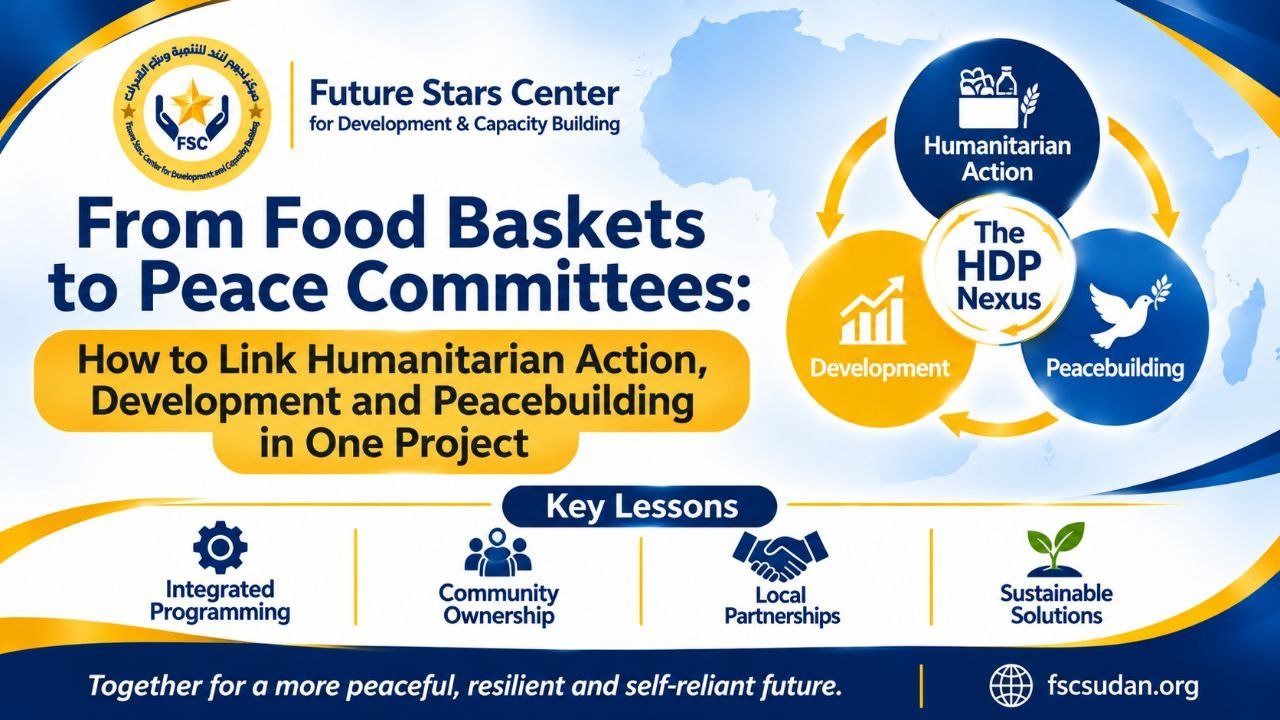
At FSC we work in Sudan and in Uganda. We organise our work in three pillars at once: humanitarian action, development and peacebuilding. Over the years we’ve learned that the nexus is not a fourth programme. It’s a set of design choices you make inside every project from the first day.
Below are the practical choices we use, with examples from our own work.
1. Plan the exit before you plan the entry
Humanitarian action is the first step, not the last. From day one of an emergency response, we ask: how will these families move to recovery, self-reliance and peace?
In practice: if you’re designing a food or cash response, put a “handover” step in the project document. At FSC, when the emergency phase ends, the field team reviews which families are ready for livelihoods, skills or peace activities, and plans the transition with the development and peacebuilding teams. A family that receives food baskets today should be on the list for a savings group or a vocational course tomorrow.
Tip: register every household once, in one beneficiary database, with data by sex, age and disability. Then the development team doesn’t have to “find” the most vulnerable families again. They’re already there.
2. Turn an emergency fix into a community asset
Water trucking saves lives, but it doesn’t last. A repaired well that the community owns does.
In practice: when FSC repairs taps, wells or hand pumps, we also help a community committee manage and maintain the source. The same water point does three jobs at once:
- Humanitarian: safe water now.
- Development: a long-term service run by local people.
- Peace: a shared resource managed jointly by displaced and host families. In Darfur, competition over water is one of the most common causes of local disputes.
Tip: put women, youth and persons with disabilities on the committee. Give them real roles, not token seats.
3. Make fair selection your first peacebuilding activity
Aid can create conflict. If host communities see displaced families receiving help while their own needs are ignored, resentment grows fast.
In practice: before any distribution we do a short conflict analysis alongside the rapid needs assessment, within 72 hours where we have access. Selection criteria are written down and published. A committee that includes youth, women and persons with disabilities checks the lists. Complaint boxes, a phone line and help desks are at every site, and we go back to tell the community what we changed. Where host families are in need too, we include them.
Nobody calls this “peacebuilding” in the logframe, but it may prevent more conflict than any workshop.
4. Use your peace networks as your early-warning system
The links go in both directions. Peace work also makes aid faster and better.
In practice: FSC runs the Ajaweed early-warning observatory and supports community peace and protection networks. They combine in-person monitors with digital platforms. When the networks report new displacement, attacks, floods or disease, the alert reaches our programme team the same day. The response can be a dialogue meeting, a message to leaders, or a humanitarian response. The same network that prevents a dispute also tells us where families have just arrived with nothing.
The Ajaweed name is deliberate. We build on respected local traditions of mediation, such as the Ajaweed and Judiyya, while upholding human rights.
5. Put local responders at the centre, not at the end of the chain
Sudan’s emergency response rooms and mutual aid groups (local initiatives) were feeding people long before most international funding arrived.
In practice: FSC’s communal kitchens in displacement sites are often run with local emergency response rooms and mutual aid groups. We support them, learn from them and never take over their role. The kitchen meets an immediate need. Over time the same groups get organisation-building support: a constitution, leadership, simple finance and small grants with light reporting. That makes them stronger for the next crisis. Strong local groups are the best guarantee that change lasts.
This reflects FSC’s own story. We began as a youth volunteer initiative and grew into a national organisation.
6. Use small grants to build social cohesion, not just income
Micro-grants are usually treated as a livelihoods tool. They can also be a peace tool.
In practice: in a MGs-supported project in North Darfur, FSC worked with 37 community micro-grant initiatives, with two phase in 2025- 2026. When communities design and run their own initiatives, they decide their priorities together, manage resources transparently and are accountable to each other. Those habits are what social cohesion looks like day to day.
Shared economic projects work the same way: a joint market or a cooperative gives refugees and hosts, or rival groups, a common interest in stability.
7. Bring creativity into peacebuilding
Peace isn’t built only around a negotiating table.
In practice: through FSC’s project “Supporting Social Innovations for Enduring Peace in Darfur”, we formed creatives’ networks in ten North Darfur localities: artists, musicians, theatre makers and young content creators carrying peace messages. Combined with training on leadership, countering hate speech and disinformation, these networks offer young people an alternative story. We think this matters a great deal when false information can turn tension into violence within hours.
8. Link skills to markets, and young people to a future
A skill only changes a life when it brings income. A young person with work and income is far less exposed to recruitment by armed groups.
In practice: before choosing a course, we do a simple market check. What do local buyers want? Courses are short and practical, at least two-thirds practice. They end with a test, a certificate and, where possible, a start-up kit, a savings-group loan or a link to an employer. We then mentor graduates for at least six months. That is development work, and in places like Darfur it is also violence prevention.
A simple checklist for your next project
If you want to design a HDP nexus project, ask these questions at the design stage:
- Conflict analysis: Does this project start with one, and will we update it?
- Selection: Are the criteria public, and does the community check the lists?
- Transition: Who receives emergency aid, and how will they move into livelihoods?
- Ownership: Which local group will own each asset (well, kitchen, market) after we leave?
- Early warning: Is there an early-warning link that can trigger a humanitarian response?
- Inclusion: Are women, youth and persons with disabilities in decision-making roles?
- Measurement: Do we measure trust between groups as well as people reached?
Final thought
The nexus doesn’t need a bigger budget. It needs projects designed by people who see the whole family and the whole community, not only their own sector. FSC is documenting this approach, including our MGs model, and plans to publish it by 2030 so that other local organisations can use and improve it.
I’d like to hear from colleagues: what has worked for you in linking emergency response with recovery and peace?
#HDPNexus #Humanitarian #Peacebuilding #Sudan #Darfur #Uganda #LocalLeadership #Localisation #Development #RefugeeResponse#FSC Vision 2030