Empowering Farmers in Shanghal Tobaya: The Qadiroon Youth Initiative
A youth-led volunteer group is helping displaced farming families move from relief toward self-reliance.
Qadiroon (“Capable”) is a youth-led volunteer initiative working in the humanitarian field. It began in Al-Fashir, where its members helped provide safe drinking water, community kitchens, medicine and food to people affected by the conflict, including patients in local hospitals. The group has since continued its work in Shanghal Tobaya locality, focusing on families living in shelter centers.
The Challenge
Farming communities in the shelter centers face several overlapping problems:
- Limited access to basic agricultural inputs such as seeds and equipment
- No effective cooperative structures to improve production and marketing
- Few trade opportunities and weak livelihoods
- A shortage of cash liquidity
- A need to strengthen social cohesion and peaceful coexistence among different groups
What the Initiative Delivered
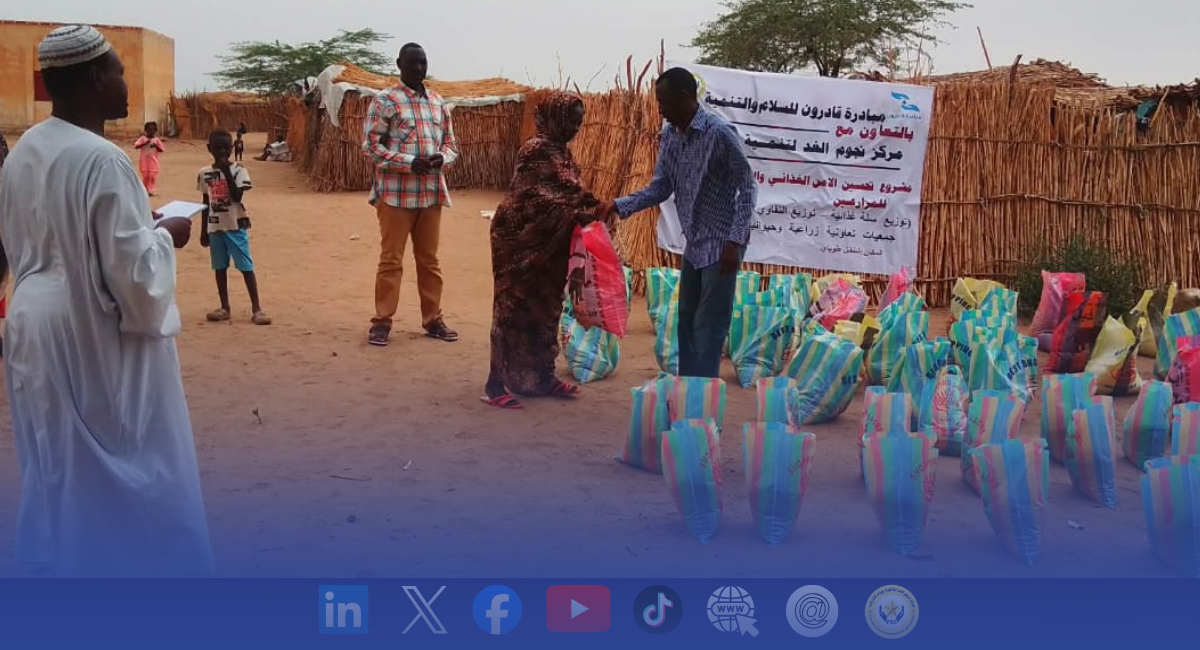
Food and farming support. Forty farmers (20 women and 20 men) received food baskets containing millet, sugar, onions, lentils, cooking oil, salt and pasta. They also received improved watermelon, onion and okra seeds, along with agricultural spraying pumps to help them return to production.
Cooperative associations. Two cooperative associations, one agricultural and one livestock-focused, were established with 15 members each (8 men and 7 women). These give farmers and herders a collective framework to improve production, reach markets and strengthen their income.
Financial inclusion and entrepreneurship. An awareness session reached 150 households on opening digital bank accounts through the Bankak app, along with entrepreneurship and e-commerce skills. The activity was added in response to the cash shortage in the area, to make everyday financial transactions easier.
Community-Led by Design
The initiative was designed with the community, not for it. The team held direct meetings with displaced representatives, farmers and herders, along with separate discussion groups for women, men and youth. Beneficiaries were identified together with local administrations and shelter-center leaders to ensure fair, unbiased selection.
To keep the process accountable, the team set up secure feedback boxes at distribution sites, shared contact numbers for the implementation team, and reviewed complaints and suggestions weekly. This allowed distribution schedules and selection criteria to be adjusted based on community input.
Impact
- Stronger food security: Urgent food needs were covered while farmers regained the means to grow their own food.
- Better livelihoods: Cooperatives and new skills improve farmers’ prospects for production and trade.
- Digital and financial inclusion: Beneficiaries gained practical knowledge to manage money in a cash-scarce environment.
- Social cohesion: Equal representation of women and men, and fair distribution, helped reduce tensions between displaced people, farmers and herders.
Lessons for the Future
The team highlighted three lessons: review budgets and target figures early to ensure accuracy and transparency; adapt activities quickly to field realities; and keep gender balance and close coordination with local stakeholders at the center of every intervention.
Looking Ahead
The experience of Qadiroon shows that lasting support begins with empowering people, not only assisting them. By combining food support, farming inputs, cooperatives and financial skills, the initiative is helping displaced farming families build stability from the ground up.